Your dog ignores commands the moment something interesting appears. They pull on the leash. They refuse to come when called at the park.
Meanwhile, you’ve seen videos of military working dogs performing flawlessly in chaotic environments. Helicopters overhead. Explosions nearby. Crowds of people everywhere. These dogs remain focused, responsive, and calm.
What makes the difference? It’s not the breed. It’s the training methodology.
Military K9 training principles can transform ordinary family dogs into reliable, well-behaved companions. The same focus on clarity, consistency, and real-world application that creates elite working dogs also creates pets who listen in everyday situations.
What Is Military K9 Training and Why Does It Work?
Military K9 training refers to the structured methodology used to prepare dogs for demanding work alongside armed forces personnel. These techniques emphasize reliability under pressure, clear communication, and consistent performance regardless of environmental distractions.
What Core Principles Define Military Dog Training?
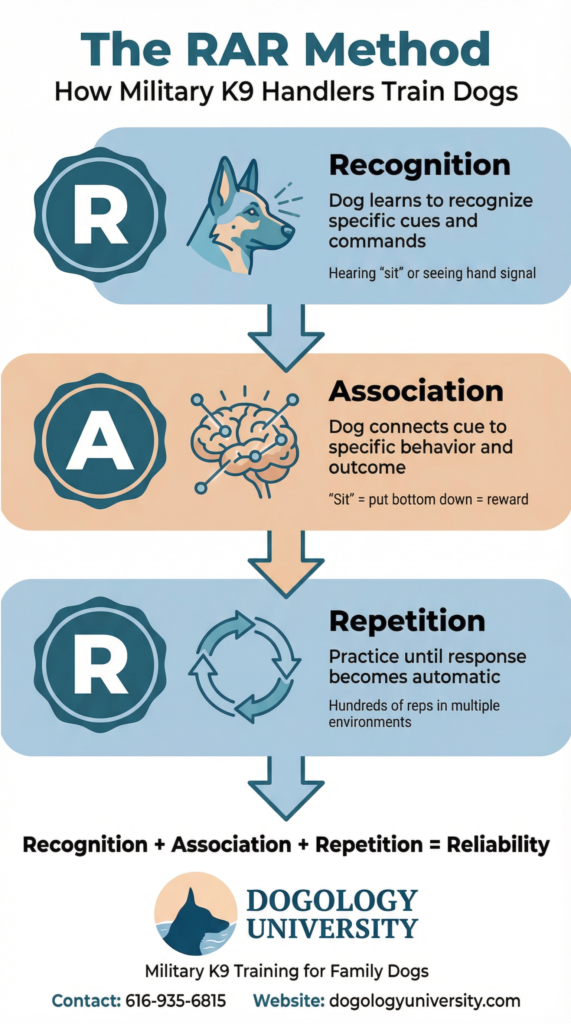
Military trainers use a formula called RAR: recognition, association, and repetition. Dogs learn to recognize cues, associate those cues with specific behaviors, and repeat the pattern until the response becomes automatic.
Voice modulation plays a critical role. Handlers use distinct tones for different purposes. Praise sounds different from commands. Corrections sound different from encouragement. This clarity helps dogs understand exactly what their handler wants.
Timing matters tremendously. Military handlers deliver feedback within seconds of the behavior. This immediate connection between action and consequence accelerates learning and prevents confusion.
The American Kennel Club notes that reliable responses require dogs to associate commands with positive outcomes consistently. Military training excels at creating these strong associations through structured, repetitive practice.
How Do Working Dogs Stay Focused in Extreme Environments?
Military dogs train in progressively challenging environments. They start in quiet spaces and gradually face more intense distractions. By the time they deploy, nothing surprises them.
This progressive exposure builds what trainers call “proofing.” A proofed behavior holds up under pressure because the dog has practiced it in countless scenarios. The environment becomes irrelevant to the response.
Handlers also train dogs to focus on them rather than surroundings. This handler-focus becomes the anchor that keeps dogs steady when chaos erupts around them.
How Can Family Dog Owners Apply Military Training Principles?
You don’t need military-grade challenges to benefit from military training methodology. The same principles that create reliable working dogs create reliable family pets. The application just looks different.
What Does Real-World Dog Training Look Like?
Real-world dog training means practicing commands in environments where you actually need your dog to listen. Not just your living room. Not just your backyard. Parks, sidewalks, pet stores, and anywhere else life takes you.
Too many dogs learn to sit perfectly at home but fall apart at the vet’s office. They walk nicely down quiet streets but pull frantically near other dogs. The training didn’t transfer because it only happened in controlled settings.
Military methodology addresses this by building behaviors in stages. First, the dog masters the skill in a simple environment. Then distractions increase gradually. Finally, the dog performs reliably in complex, unpredictable situations.
This approach takes more time initially but creates lasting results. A dog trained this way actually listens when you need them to, not just when conditions are ideal.
Why Does Consistency Matter So Much?
Military handlers maintain absolute consistency. Every team member uses identical commands, identical criteria, and identical consequences. The dog never has to guess what different people want.
Family dogs often receive mixed signals. One person allows jumping while another discourages it. Commands vary between family members. Criteria shift depending on mood or circumstances.
This inconsistency confuses dogs and weakens training. They learn to test boundaries because sometimes breaking rules works. Consistent expectations eliminate this guessing game.
Establish household rules before training begins. Everyone agrees on commands, acceptable behaviors, and consequences. Then everyone follows the same protocol without exception.
What Training Methods Bridge Military and Family Applications?
Several specific techniques translate directly from military K9 programs to family dog training. These methods work because they align with how dogs naturally learn and respond.
How Does Structured Obedience Build Impulse Control?
Impulse control separates well-trained dogs from chaos. Military dogs master this skill because their work demands it. A dog that acts on every impulse cannot perform reliably in high-stakes situations.
The place command teaches dogs to stay on a designated spot until released. This builds duration and impulse control simultaneously. Dogs learn to wait through distractions rather than reacting immediately.
Threshold training requires dogs to wait at doorways instead of bolting through. This everyday exercise reinforces the concept that patience gets rewarded while impulsive behavior gets nothing.
Delayed rewards teach dogs to sustain behaviors. Instead of treating immediately after a sit, handlers ask for a longer hold before delivering the reward. This extends the dog’s ability to maintain focus.
What Role Does Handler Communication Play?
Military handlers develop precise communication skills. They use body language, vocal tone, and timing to convey clear information to their dogs. Misunderstandings rarely occur because the communication system is well-defined.
Body language often speaks louder than words. Your posture, movement, and positioning tell your dog as much as verbal commands. Consistent body language reinforces verbal cues and makes them more reliable.
Vocal tone affects how dogs interpret commands. A firm, clear tone for obedience differs from an excited tone for play. Using distinct tones for different contexts helps dogs understand what mode they’re in.
According to Whole Dog Journal, rewarding dogs frequently during training ensures they believe the behavior is worth maintaining. Military trainers understand this and maintain high reward rates during skill-building phases.
How Does Environment Training Create Reliable Dogs?
The biggest gap between trained and unreliable dogs is environment generalization. Dogs don’t automatically transfer skills from one setting to another. Each new environment requires deliberate practice.
Why Do Dogs Act Differently in New Places?
Dogs learn contextually. They connect commands not just to behaviors but to the entire situation where learning occurred. Your living room, your voice, your specific body position become part of the cue.
When any element changes, the dog may not recognize the command. The new park doesn’t look like the training room. The distractions are overwhelming. The cue gets lost in unfamiliar context.
Military dogs overcome this through extensive environment exposure during training. They practice the same skills in dozens of locations until the behavior itself becomes the constant rather than the setting.
How Do You Build Environment-Proof Behaviors?
Start training in your easiest location. Master the behavior there first. Then move to slightly more challenging environments and rebuild the skill.
Expect some regression when environments change. Your dog isn’t being stubborn. They genuinely need to relearn the behavior in the new context. Patience during this phase pays off.
Gradually increase difficulty over weeks and months. Quiet park, then busier park, then downtown sidewalk. Each successful level builds confidence for the next challenge.
Document which environments your dog has mastered. Systematically expand the list until reliability exists everywhere you need it.
What Benefits Do Families See From Structured Training?
Families who implement military-inspired training methodology report significant improvements in their dogs’ behavior and their own confidence as handlers.
How Does Training Improve Daily Life?
Dogs with solid obedience training are easier to live with. They don’t bolt out doors. They greet guests politely. They walk nicely on leash. These skills transform daily interactions from stressful to enjoyable.
Travel becomes possible when your dog can handle novel environments. Vet visits go smoothly when your dog maintains focus despite stress. Social situations work when your dog knows appropriate behavior.
The relationship between dog and owner strengthens through training. Clear communication builds trust on both sides. Dogs feel more secure knowing expectations. Owners feel more confident knowing their dogs will respond.
What Long-Term Outcomes Can Families Expect?
Structured training creates lasting behavioral change rather than temporary compliance. Dogs trained with these methods maintain their skills over time because the foundation is solid.
Safety improves dramatically. Reliable recall can save a dog’s life. Impulse control prevents accidents. Appropriate greeting behavior keeps visitors from getting injured.
The investment in training during early months pays dividends for years. A well-trained dog requires less management, causes fewer problems, and participates more fully in family activities.
How Does Dogology University Apply Military Training Principles?
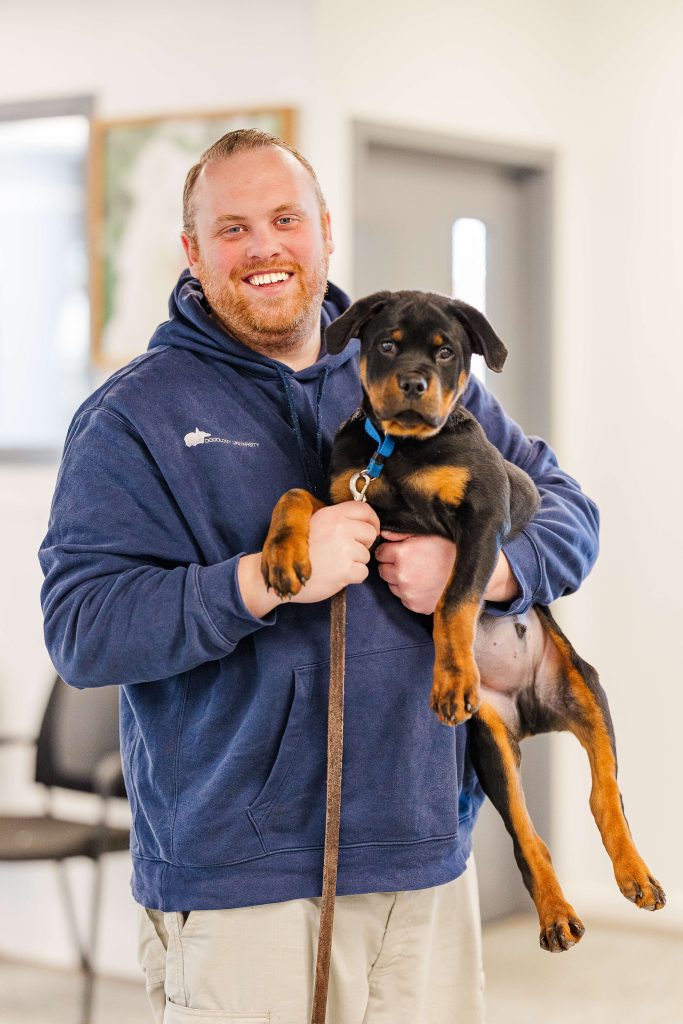
At Dogology University, founder Matthew Lamarand brings U.S. Air Force K9 handling experience directly to family dog training in West Michigan. This military background shapes every aspect of the training methodology.
What Makes This Approach Different?
The training emphasizes real-world dog training in actual environments. Sessions happen at parks, neighborhoods, and public spaces throughout Grand Haven, Holland, Saugatuck, and surrounding communities. Dogs learn to perform where performance actually matters.
The balanced, practical approach focuses on building trust, focus, and consistency between dogs and their owners. Training combines military K9 precision with family-friendly techniques appropriate for everyday life.
Matthew’s Clear Communication Training Method applies the same principles he learned as an explosive detection K9 handler overseas. If you can train a dog to reliably detect explosives in war zones, you can train a family dog not to pull on leash.
What Programs Apply These Principles?
Mobile Day School takes dogs to real locations throughout West Michigan. This approach ensures skills transfer to the environments where families actually need them.
Private training sessions bring personalized instruction directly to families. This in-home approach addresses behaviors specific to each dog’s living situation.
Military Precision Meets Family Life
Military K9 training principles work because they align with how dogs actually learn. Clarity, consistency, progressive challenge, and real-world application create reliability that survives outside training sessions.
Your family dog may never need to perform in a war zone. But the same methodology that prepares dogs for extreme situations also prepares them for the everyday challenges of family life.
The difference between a dog who listens at home and one who listens everywhere? Real-world training. The difference between temporary compliance and lasting behavior change? Military-grade consistency.
That’s trained. That’s real-world training.
Ready to bring military-grade training to your family dog? Contact Dogology University for a free consultation. We’ll assess your dog’s needs and build a training plan that creates the reliability you’re looking for.
Call: 616-935-6815Email: info@dogologyuniversity.com
Hours: Monday – Friday, 9:00 AM – 5:00 PM
Service Areas: Grand Haven, Holland, Saugatuck, Greater Grand Rapids
FAQs
Yes. Military K9 training emphasizes clarity, consistency, and real-world practice—principles that apply to any dog. The methodology translates directly to family pets.
RAR stands for Recognition, Association, and Repetition. Dogs learn to recognize cues, associate them with behaviors, and repeat until the response becomes automatic.
Dogs learn contextually. They connect commands to the environment where training happened. Real-world training in multiple locations builds reliability everywhere.
Timeline varies by dog and behavior. Simple commands may take 4-8 weeks. Complex behaviors requiring environment exposure can take 3-6 months of consistent practice.
Military training emphasizes real-world application, absolute consistency, progressive challenge, and handler focus. Regular training often happens only in controlled settings.